"Rigid core" has become shorthand for a whole family of waterproof floor constructions, and buyers often receive contradictory definitions of what VSPC adds over SPC. Both cores come from the same principle — PVC resin plasticated with stone powder and extruded into a dimensionally stable, 100% waterproof board. The differences that matter are practical: profile height, underlay, format range, and which collection carries the aesthetic your project needs.
What SPC delivers as the baseline
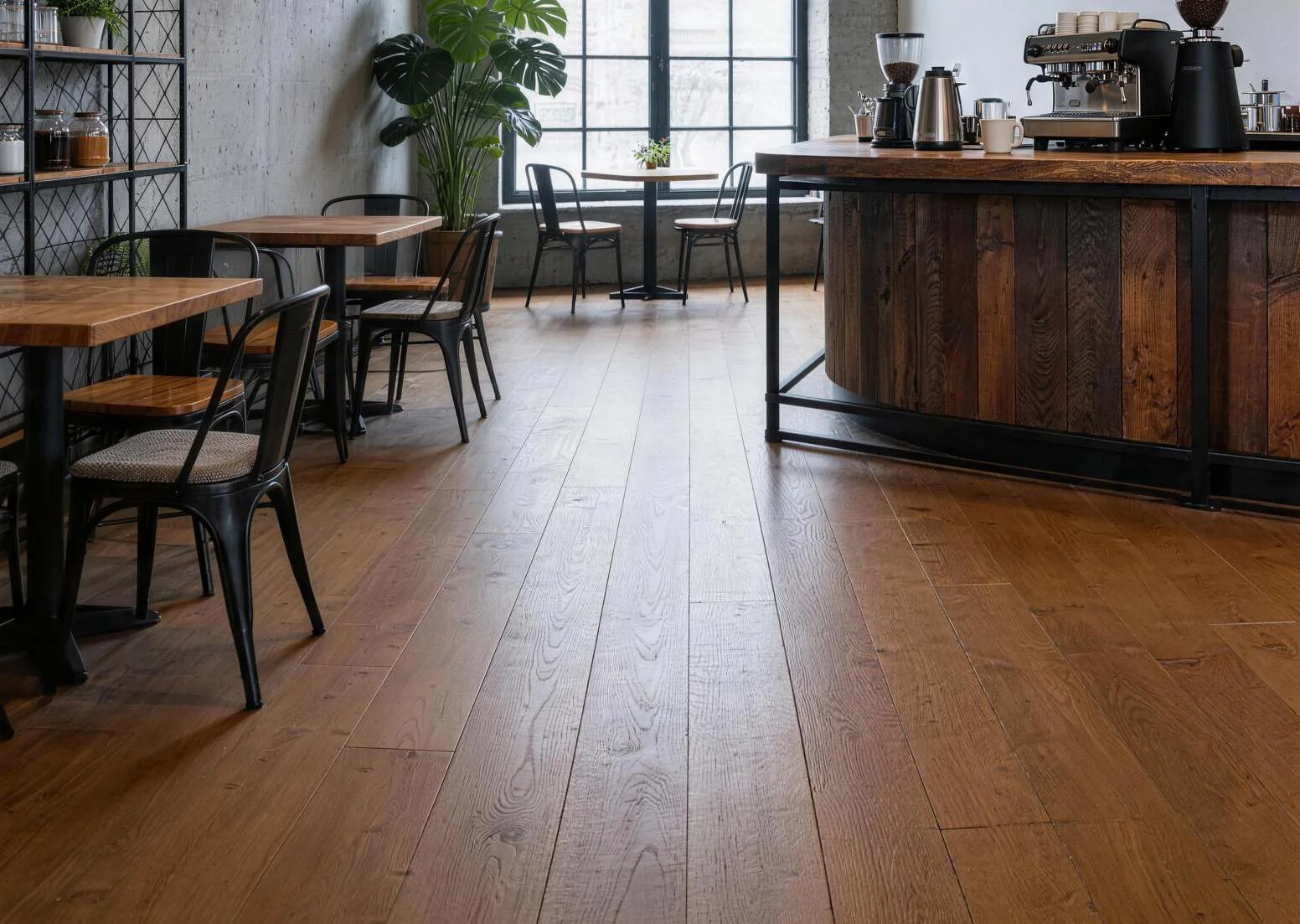
An SPC core absorbs no moisture, resists expansion and contraction, and locks together without adhesive, making it the workhorse for wet and high-traffic commercial areas — bathrooms, cafes, retail floors. Its dimensional stability means open-plan installations hold their joints through humidity swings that would trouble traditional vinyl, and the click installation keeps labor cost per square meter low on large projects.
What VSPC adds: the ultra-slim waterproof floor
VSPC pushes the same waterproof performance into an ultra-slim 8–8.5 mm profile with a built-in silent underlay — quieter underfoot than a bare rigid core, and low enough to transition cleanly against existing floor finishes in renovation projects. Planks run 1220 × 166 mm, and the system extends into 550 × 550 mm parquet at 13 mm, including herringbone and chevron patterns that used to demand engineered wood and its moisture limitations. For hotels and apartments renovating occupied floors, slim profile plus click installation plus integrated underlay is what makes room-by-room upgrading economical.
The wood collections beside them
The rigid-core lines sit inside a broader flooring program. ZOMO Artisan Carved is solid oak with hammer-pattern and water-drop ripple carving. Neoclassicism brings engineered boards finished with a nitrogen oil-feel surface. Bohemian pairs Italian original design with hand scraping and ultra-HD digital printing on birch. Specifiers mixing zones — a carved-oak lobby against a VSPC spa floor — can source the whole program from one manufacturing and quality system.
Surface durability is shared across the range
Whichever core a project chooses, the working surface is the same technology: electron beam (EB) curing at above 99% cure degree, versus roughly 60% for thermal curing and 40–70% for UV curing. The resulting surface resists scratching, staining, chemicals, and yellowing, and carries an ENF formaldehyde-free rating across the range — the durability argument does not change between VSPC and SPC; the choice is about format and feel.
How to decide
Choose SPC where the brief is maximum waterproof durability at the lowest installed cost in wet commercial zones. Choose VSPC where renovation constraints matter — height transitions, acoustic comfort, or pattern work like herringbone — and the small format of parquet. When the project is a premium dry interior, evaluate the wood collections instead, and protect them with the same EB-cured surfaces. Requesting physical samples of both core lines side by side is the fastest way to feel the difference.