
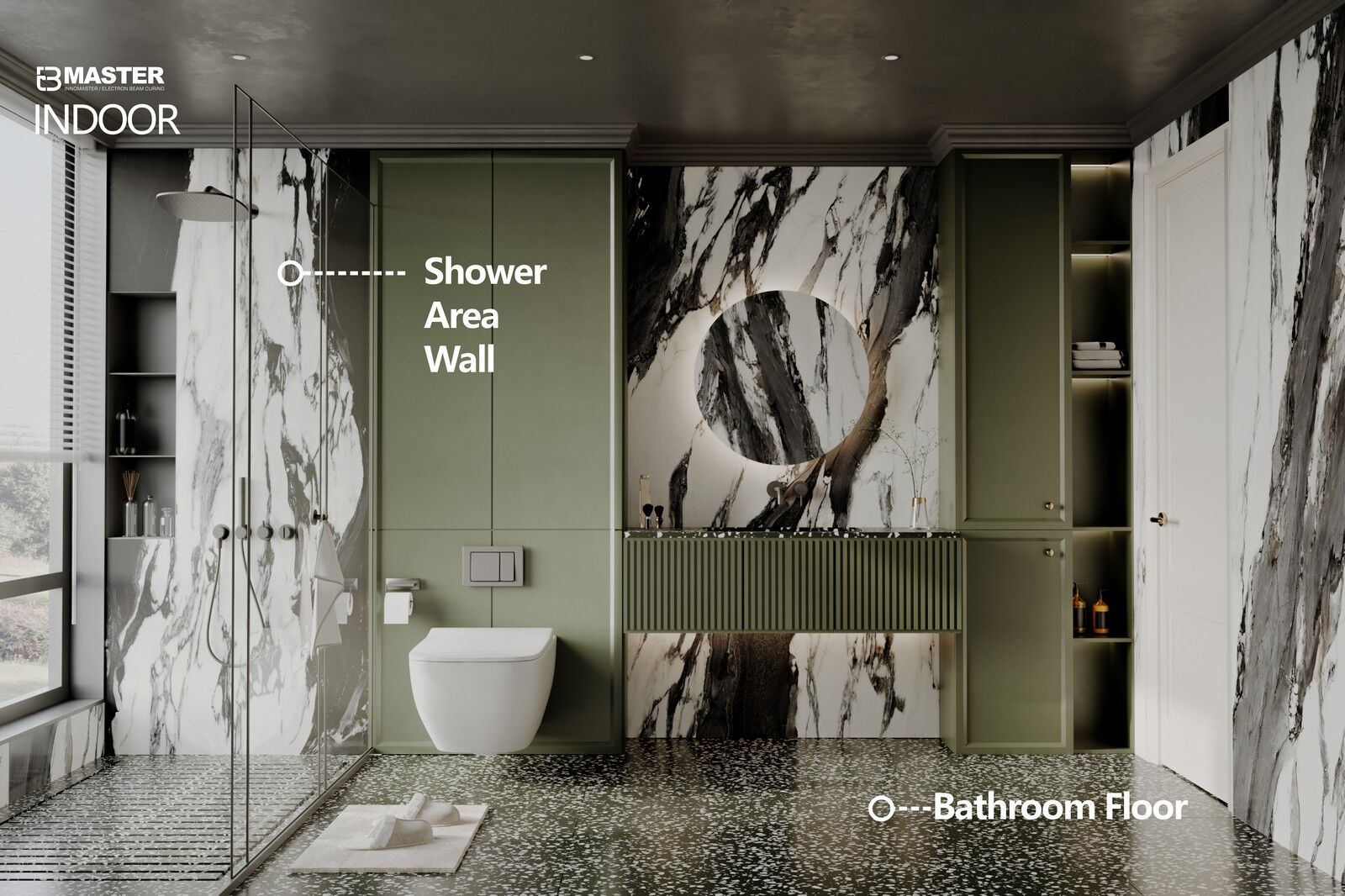
Renovating a bathroom or hotel wet area has followed the same script for decades: demolish the old finish, rebuild the substrate, and wait — on membranes, mortar, and grout, each with its own curing window. Waterproof SPC wall panels change that script. This guide compares the two approaches across the factors contractors and developers actually price: installation time, waterproofing performance, maintenance, and design range.
The installation gap: days of curing vs. hours on the wall
A traditional tile project is a chain of dependent stages. The existing finish comes off, the substrate gets repaired and leveled, a waterproofing membrane goes on and cures, a mortar bed sets each tile, grout fills the joints, and the assembly needs further time before the room returns to service. Every stage waits on the one before it, so a single bathroom commonly stays out of service for days.
SPC panels take a different path: verify the substrate is sound, clean, and level, then bond the large-format panels directly over the existing tile, plaster, concrete, or plasterboard with structural adhesive. Panels come in 1210 × 2450–3200 mm sheets at 3.6–5.0 mm thick, so a wet-area wall is covered in a handful of pieces instead of hundreds of tiles — allowing bathrooms to be completed in hours rather than days, and cutting overall renovation timelines by up to 60%.
The demolition-free method also removes the dust, noise, and debris of chipping off old tile. That matters most in occupied buildings — hotels renovating room by room, hospitals upgrading wards, or multifamily projects where residents stay in place.
Waterproofing performance: body vs. coating
Tile assemblies rely on layers: the ceramic face is waterproof, but the system depends on a membrane and grout lines that age, crack, and wick water into the wall. Failures usually start where the finish is weakest — in the joints.
An SPC panel is waterproof through its body, not by coating. The core is made by plasticating and extruding PVC resin with stone powder into a dense board that absorbs no moisture, with no adhesives and no formaldehyde. The surface is mold-resistant, and because the 5.0 mm panels join with grout-free lock splicing, there are far fewer joints to maintain — or to fail.
Maintenance over the lifecycle
In service, grout is the recurring cost of tile: it stains, hosts mold in wet areas, and needs periodic cleaning and resealing. Panel surfaces are sealed with electron beam (EB) curing at above 99% cure degree, producing a dense finish that resists staining, scratching, chemicals, and yellowing — and wipes clean without specialty products. For hotels and healthcare facilities, that translates into faster room turnaround and a lower cleaning bill for the life of the finish.
Design range without the tile catalog limits
Ceramic and porcelain ranges are bounded by what factories press and glaze. Digitally printed panels are bounded only by print resolution: 147 decors across nine surface families — muted tones, wood grain, fabric, sandstone, concrete, terrazzo, marble, gemstone, and artistic accents — with Swedish NCS color matching to keep tone consistent across large commercial rollouts and repeat orders.
When tile is still the right call
Panels are not a universal replacement. Small-format mosaics and deliberately irregular handmade tile remain a design statement large-format boards cannot replicate; curved surfaces and complex geometries favor small units; and continuous direct high-heat exposure calls for assemblies tested for that duty. On flat walls in wet and high-traffic areas — the majority of bathroom, hotel, and healthcare projects — the panel case is straightforward.
Specification confidence comes from the paperwork: INNOMASTER SPC panels carry French A+ VOC, ROHS, CE, and ISO 14001 certifications, with test reports available for project submittals.
The bottom line
Where the brief is a waterproof, low-maintenance, fast-installing wall finish in a wet area, direct-bond SPC panels beat traditional tile on schedule, lifecycle cost, and joint-free hygiene — while matching it on design. Request a quote and physical samples of any decor code to judge the surface for yourself.